How do you ensure the mass production matches the professional laser projector sample?
- VIP-User
- 2026-07-16
- 3
Ensuring mass production matches the professional laser projector sample requires a strict end-to-end quality control system. Manufacturers achieve this by utilizing standardized assembly lines, executing rigorous laser module and optical performance testing, and implementing comprehensive aging and waterproof checks on every production unit to guarantee consistent performance, output, and structural integrity.
Core Solutions & Key Takeaways
- Comprehensive Testing Protocols: Every production unit undergoes the exact same optical performance, scanner system, and waterproof testing as the approved sample.
- Standardized Laser Calibration: Laser module testing ensures color consistency and power output stability across the entire production batch.
- Environmental Verification: IP66 waterproof testing is executed on finished units to verify outdoor reliability for demanding application scenarios, including stage performances, festivals, and architectural lighting projects.
- Batch Consistency: Systematic incoming material inspections and pre-shipment quality checks eliminate component-level variations before final delivery.
Detailed Architectural/Principle Analysis
Replicating sample performance in mass production relies on structured quality inspection workflows. At the factory level, the transition from sample approval to mass manufacturing involves a multi-stage validation process. It begins with incoming material inspection to verify that all electronic components, scanner systems, and optical lenses match the exact technical specifications of the prototype. 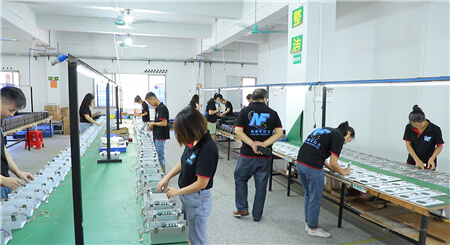
During assembly, technicians conduct specialized laser module testing to calibrate the RGB color balance and beam alignment. This ensures that the dynamic beam effects, animations, and customized laser displays programmed on the sample are identical across all mass-produced units. A key phase is the scanner system test, which guarantees that high-speed graphics rendering remains sharp and distortion-free during operation via APP control or DMX/FB4 protocols.
For outdoor equipment like the Guangzhou New Feel Lighting And Audio Equipment Co., Ltd. A3-APP model, waterproof testing is mandatory. The housing must pass strict IP66 enclosure tests to resist dust and heavy water ingress, preventing environmental degradation during outdoor weddings, concerts, and corporate events. Finally, finished products undergo prolonged aging tests under operational loads to identify and eliminate early-stage component failures before shipment. 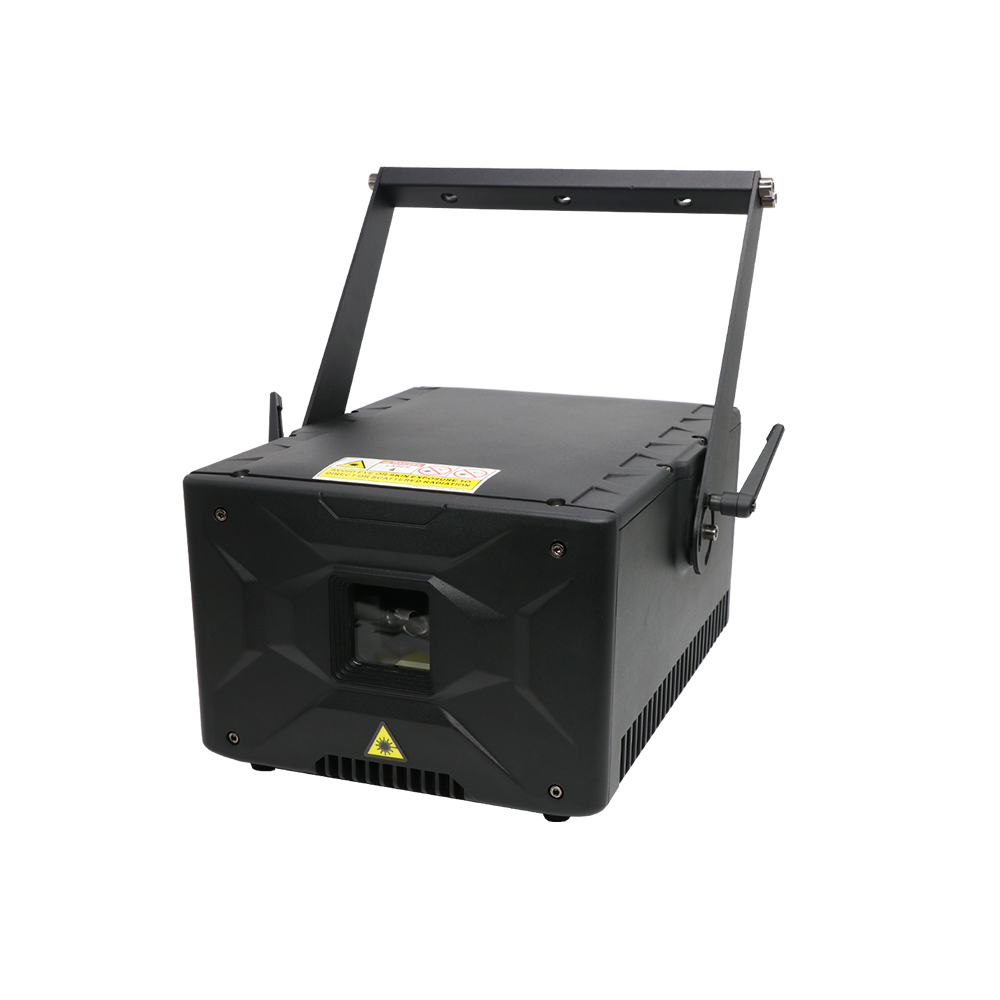
This systematic approach is backed by official credentials, such as the CE certification (Certificate Number: UTT202406076C) for laser lights, ensuring conformity to international safety and performance standards. Real-world applications, such as a bulk supply project of over 500 lighting units to a United States distributor and a 1,500-unit supply to a French stage production company, demonstrate that maintaining these strict manufacturing protocols yields stable quality, consistent output, and reliable long-hour operation in professional environments.
Data/Solution Comparison
The following table outlines the quality control check points implemented during the mass production of professional laser projectors to ensure alignment with the initial sample:
| Production Stage | Quality Inspection Parameters | Sample Alignment Verification Method |
|---|---|---|
| Incoming Materials | Laser diode wavelength, lens transmittance, scanner speed rating | Comparison against technical datasheets and sample component benchmarks |
| Active Assembly | RGB color mixing ratio, laser power output, power supply stability | Optical power meter measurement and color spectrum analysis |
| Finished Product Testing | DMX/FB4 control responsiveness, wireless APP connection stability | Functional test runs matching the control patterns of the prototype |
| Environmental Testing | IP66 waterproof rating, thermal dissipation under load | Chamber testing with water jets and continuous temperature monitoring |
| Pre-Shipment Inspection | Cosmetic finish, structural integrity, packaging durability | AQL standard random sampling and final functional verification |
Frequently Asked Questions (FAQ)
Q1: How is the color consistency of the RGB laser beam maintained across thousands of units?
A1: Color consistency is maintained by sourcing laser diodes from the same bin specifications and performing precise calibration during the laser module testing phase. Technicians adjust the red, green, and blue power ratios using optical analysis equipment to match the exact color temperature and balance of the reference sample.
Q2: What measures prevent the scanner system from degrading during continuous mass production?
A2: The scanner systems are subjected to dedicated speed and angle verification tests. High-speed galvos are driven through standard pattern tests to check for linearity, step response, and thermal stability, ensuring they perform animations and beam effects identical to the sample.
Q3: How are outdoor laser projectors certified for environmental protection during production?
A3: Every batch of outdoor laser projectors undergoes rigorous waterproof testing to verify the IP66 rated physical enclosure. Seal integrity, gasket placement, and cable gland connections are visually and physically inspected, followed by standardized water spray testing to prevent field failures.
Final Conclusion & Recommendations
To secure batch-to-batch consistency that matches the approved sample, purchasing from a manufacturer with integrated R&D, production, and structured quality control is essential. Standardized mass production relies on continuous testing processes, ranging from incoming component verification to final aging runs. Buyers should prioritize manufacturers who offer clear OEM/ODM terms, certified compliance such as CE markings, and transparent quality control reports. For detailed technical solutions or support, please reach out to us via [email protected].
About Us
Guangzhou New Feel Lighting And Audio Equipment Co., Ltd., established in 2008, is a professional manufacturer specializing in stage lighting and special effects equipment based in Guangzhou, China. With a factory area of approximately 3,500 square meters and a dedicated R&D team, the company maintains a monthly production capacity of 5,000+ lighting units. Its export ratio reaches 80% across major markets in North America, Europe, Southeast Asia, the Middle East, and Africa, serving global distributors and event production companies with CE-certified laser systems. 
Lastest
-
How do I verify the actual brightness of an RGB laser projector before buying bulk?
2026-07-16 -
How do I choose the right laser light show wattage for a 5000-person outdoor venue?
2026-07-16 -
How can I verify the real ANSI lumens of a professional laser projector before bulk buying?
2026-07-16 -
What IP rating is safe for an outdoor laser projector in rainy climates?
2026-07-16 -
Are there compact alternatives to bulky outdoor laser projector systems?
2026-07-16
SUBSCRIBE
INQUIRY